• Home
  • Traveling Patagonia
  • Road Trips
  • Nature Expeditions
  • Trekking
    • Day Tours
    • Muti-day Expeditions
  • Birding Tours
    • Day Tours
    • Overnight Tours
    • North Patagonia Birding Tour
    • From the Atlantic Coast to the Andes
  • Logistics
  • Contact Us
  • About
  • Blog
  • Español

Copyright © 2016 Tierras Patagónicas

Indigenous Peoples of Patagonia (I)


Before the Spanish conquerors arrived to America and later, during the second half of the XIX century, the armies of the new estates of Argentina and Chile launched their military campaigns, Patagonia and the Pampas where populated by different indigenous Peoples. Those Peoples have historically being called under the generic term of “Mapuche”, or “Araucanians”, as the Spanish used to call them. Nevertheless, originally those Peoples we not a homogeneous group, but diverse Peoples that were slowly absorbed both culturally and militarily but the Araucanians, in a long process of more than two hundred years called “the araucanization of the pampa”.

This process is still not very well-known, as there are not enough verified historical data. Even the real conformation of the Peoples and ethnic groups that intervened in this process is a complex matter, subject to discussion among the experts. Nevertheless, in this post we will try to make a brief description of who these Peoples were, according to the information available. We insist that this a subject under a lot of debate, especially on the last few years, as the Mapuche people claims have become more strong and organized. Therefore, we do not intend to take anything for granted, but just try to understand a little better both the history and the present situation.

THE MAPUCHE O ARAUCANIANS

The people originally called Mapuche (from the mapundungun language: Mapu, land and Che, people, so “People of the land”) were native of the region between rivers Bío Bío and Toltén, in the northernmost part of the Chilean Patagonia. They were relatively sedentary, doing an incipient ranching and farming. They were divided in several groups, each one commanded by a chief or cacique, who resolved their frequent conflicts in bloody armed confrontations.

The Spanish Conquerors stumble upon them when the troops led by Pedro de Valdivia, who were moving south from Santiago de Chile, met the Araucanians in a place called Quilacura, south of Bío Bío River. The Mapuche fought with fierceness never seen by the Spanish, and although the latter barely won the first battle, they were severely damaged, so Valdivia decided to retreat. That was the start of the Arauco War, which lasted almost 300 years, until Chile’s independence. Still, there were long periods of peace. According to Philip II of Spain, this was the armed conflict who took more Spanish lives on the New World. For that reason it was called the “Indian Flemish”.

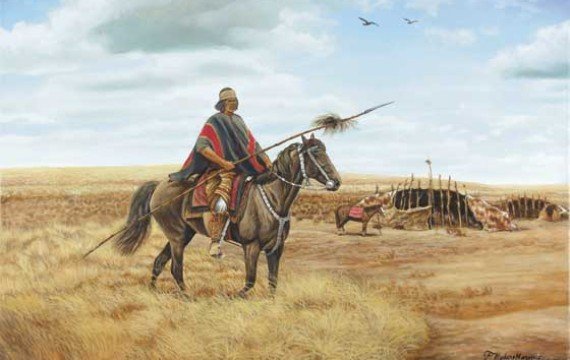
Malón al atardecer. Della Valle, Angel

As a result of the fierce resistance of the Mapuche people to the Spanish advance in the south of Chile, after almost 100 years of bloody battles between the armies leaded by García Hurtado de Mendoza and Pedro de Villagra and the Mapuches, leaded by legendary caciques like Lautaro and Caupolicán, in 1641 an unusual event on the history of the Spanish Conquers in America took place: the Governor of Chile, Francisco López de Zúñiga, agreed on a parliament with the principal Mapuche chiefs to acknowledge them as a sovereign entity, entitled to use a part of the territory of the General Captaincy of Chile, with clear borders that the Spanish committed to respect. The Mapuche nation received then a formal acknowledgement by the conquerors; the Mapuche, in return, declared themselves subject of the Spanish Crown.

But the territory given was too small for a bellicose group like the Mapuche people, so big groups of them started to cross the Andes towards the huge plains of what today is Argentina. Most probably they did it attracted by the enormous amount of feral cattle (cows, horses and sheep) wandering on the pampas, which were a very valuable resource. These cattle was introduced in the pampas by the Spanish, during the two establishments of Buenos Aires, in 1536 and 1580, and breed by thousands since then, due to the excellent conditions of the wet pampas for these animals.

Indio a Caballo

When crossing the mountains and moving east, the Mapuche encountered other ethnic groups with different degrees of affinity and progress, which they started to a greater or lesser extent to incorporate. Of course this was not a one-way process, as the Mapuche people changed as well along the way. From sedentary, they became semi-nomads, incorporating the horse, changing the hut for the tent and almost abandoning their farming and industrial activities.

HULLICHE PEOPLE

The Huiliche or Williche People (from Willi, south and Che, people, “People of the South”) were the southern branch of the Mapuche People, who lived between the Toltén River and the actual Chilean provinces of Osorno and Llanquihué. Some centuries before the arrival of the Spanish Conquerors, some Huilliche groups crosses the Chacao channel to settle on the north and the centre of the Chiloé Island, where they got in touch and mixed with peoples living there, like the Chonos.

Traditionally the Huilliches have been considered as the “Southern Mapuches” and their territory the Southern Araucania. However, the last historical studies consider the Huilliches as an ethnic group on their own, although is quite obvious that they went through an “araucanization” process. In fact, their language, called chesungun is a variation of the mapudungun of the Mapuche People, but very influenced by the Spanish. This dialect is still used in some places of the Osorno and Chiloé provinces.

On the Argentinian side of the Andes the Huilliches lived in the Neuquén provinces, from the Agrio River to the Neuquén River, where they were known as the “Mountain Huilliches” or the “Apple Tree People”, as they settled on territories that where full of forest of wild apple trees. From there they moved north to the south of Mendoza, displacing their enemies, the Pehuenche People. Nevertheless, other theories say that the “Apple Tree People” emerged from an araucanization process of Tehuelche groups coming from Southern Patagonia or Huarpe People from the Cuyo Region.

Sayhueque

The Apple Tree People were probably the most “civilized” of the indigenous groups in Patagonia, in the sense that they have similar habits as the white people. They were sedentary, doing farming, herding and handcrafts like blankets, ponchos and silver ornaments.

The most important chief of what then was called “The Apples Country” was Sayhueque, who was acknowledged as the local authority by the Buenos Aires government. They even signed a peace treaty with him to avoid that the confederation led by Sayhueque, make up by Araucanians and Tehuelches, joined forces with the dreaded cacique Calfucurá, who led the indigenous groups of the pampas.

Nowadays there are indigenous people descending from the Huilliches both in Chile, from Valdivia to Chiloé, and Argentina, in the Neuquén departments of Lácar, Collón Cura, Huiliches and Catán Lil.

PEHUENCHES

The Pehuenches or “People of the Pehuén” were other of the indigenous peoples of the Mapuche culture. They got their name due to the fact that they based their diet on the recollection of pine nuts of the Araucaria (Monkey-Puzzle Tree), called Pehuén by the Mapuches. Their distribution area, therefore, coincides with the habitat of this emblematic tree of Northern Patagonia. In Argentina, the Araucaria (Araucaria araucana) can be found only on the west of Neuquén province, from the slopes of the Copahue volcano to the Hermoso Lake, south of San Martín de los Andes. In Chile the Pehuén is found in Araucanía, in the Bío Bío and Los Ríos Regions.

Araucaria seeds are highly nutritive, and the Pehuenches made flour and fermented drinks with them. They also haunted. Powerful warriors, the most bellicose of the area, the different Pehunche groups where permanently fighting each other. A man’s prestige was measured by his bravery on battles and his wealth on the amount of spouses and cattle he owned.

Araucaria (Araucaria araucana)

For battling they wore showy leather clothes, like cuirasses and helmets, crowned by flashy feathers. As weapons they used spears, stone balls and iron swords bought from the Spanish. Both men and women used big silver earrings and painted their faces in colours. Another characteristic of their culture was the conic huts made in leather, and the use of racquets to walk over the snow.

Once they got in contact with the Spanish Conquerors they gradually changed to a cattle breeders and traders society. They moved their encampments or “tolderías” to the highest areas in spring and summer, looking for better pastures. In winter they moved to the low sheltered valleys. Once they adopted the stockbreeding of the animals coming from Europe, they ate mares and cows but the Pehuenches were still skilled hunters of big animals like Deers, Guanacos and Rheas.

Pehuenche Huts

We do not know much more about this ethnic group that disappeared as such during the XVIII century. First, they were absorbed by other cultures, like the Tehuelches that came from the south and the Araucanos from Chile. Later, after the so-called Conquest of the Desert, launched by the Argentine government from 1869 to 1888, they almost disappeared, most of them crossing the Andes towards Chile.

Nowadays there are dispersed Pehuenche groups in Malargüe, South of Mendoza, in the Aluminé department in Neuquén and in Arroyo Los Berros in Río Negro provinces.

BIBLIOGRAPHY

Bandieri S. , Favaro O. y Morinelli M., Historia de Neuquén , Editorial Plus Ultra., Buenos Aires, 1993.

Bengoa, José, Historia del Pueblo Mapuche. Siglos XIX y XX. LOM Ediciones, Santiago, Chile, 2000.

Musters, George Chaworth, Vida entre los Patagones, El Elefante Blanco, Buenos Aires, 2005.

Rojas Lagarde, Jorge Luis, Malones y Comercio de Ganado con Chile, El Elefante Blanco, Buenos Aires, 2004.


2 Comments for Indigenous Peoples of Patagonia (I)


Birds of Patagonia: Green-backed Firecrown | Patagonian Lands

[…] of the tropical birds in this cold and mountainous world. That might be the reason why for the Mapuche culture hummingbirds is related with trips across supernatural worlds. The male has a bright red […]

Reply

A Birding Tour in North Patagonia | Patagonian Lands

[…] several coots, Rufous-backed Negrito, Long-tailed Meadowlark and Austral Blackbird. Native Mapuche communities occupy this area, where they live mainly from breeding sheep and goats, growing […]

Reply


Wanna say something?


  Cancel Reply

  • CONTACT

    info@tierraspatagonicas.com

    Phone: +54 2972 413 786
    Cel: +549 2944 710 762

    San Martín de los Andes
    Patagonia Argentina

  • VIDEOS

  • Photos

    • ANDEAN PATAGONIA
    • SOUTHERN PATAGONIA
    • ATLANTIC PATAGONIA
    • BIRDWATCHING PHOTOGRAPHY
  • Recent Posts

    • Birds of Patagonia: Patagonian Sierra-Finch
      (Phrygilus patagonicus) The Patagonian Sierra-Finch is an endemic species of Patagonia...
    • Pillan Mahuiza Geopark
      Pillán Mahuiza Geopark, in San Martín de los Andes, Patagonia, Argentina, spans...
    • Birds of Patagonia: Silvery Grebe
      (Podiceps occipitalis) This sublime diver and swimmer is found in almost all Argentina,...
  • Popular Posts

    • The Andean-Patagonian Forest
      The Andean-Patagonian forests, also known as Subantarctic forests, spreads over steep...
    • Ruta 40, North and Cuyo Sectors
      Ruta 40 ("Route 40"), or National Route 40 is the longest and most spectacular road...
    • A Tour to The Marble Chapels
      The "Marble Chapels", in General Carrera Lake, Chile, are mineral formations made...

  • Categories

    Antrophology Birdwatching Books Fauna Fungi Geology History Lakes & Rivers Mountains National Parks Native People Paleontology Plants Route 40 Tours Uncategorized Volcanoes