• Home
  • Traveling Patagonia
  • Road Trips
  • Nature Expeditions
  • Trekking
    • Day Tours
    • Muti-day Expeditions
  • Birding Tours
    • Day Tours
    • Overnight Tours
    • North Patagonia Birding Tour
    • From the Atlantic Coast to the Andes
  • Logistics
  • Contact Us
  • About
  • Blog
  • Español

Copyright © 2016 Tierras Patagónicas

Perito Moreno National Park


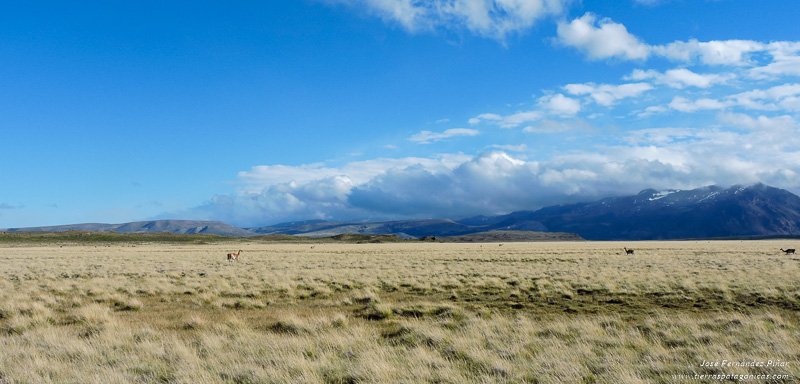
Perito Moreno National Park (do not confuse with Perito Moreno Glacier, which is 450 Km south, in Los Glaciares National Park) is a protected area on the center west of the Santa Cruz province, in the southernmost part of the Argentine Patagonia. Limiting with Chile on its west side it has a surface of 115,000 has., covering a representative mix of the Patagonian Steppe and the humid Subantarctic Forest. The area was declared national park in 1937, and due to its isolation and harsh weather it is one of the most unknown national park in Patagonia. It also the less visited, with less than 2,000 visitors per year. This, together with its minimal infrastructures, awards the visitor with the unique feeling of being in an truly natural territory, almost untouched by the man. Only the east side of the park is accesible with vehicles, the rest is not open to the public in order to guarantee the highest level of protection.

Río Volcán, Perito Moreno NP


The park is only open to the public from October to April. There is only one entrance, coming from Route 40 and doing 90 Km. by a dirt road to reach the park’s by its east side. If you are travelling south the park is 240 Km. away from the town of Perito Moreno, while if you are going north it is 210 Km. from Gobernador Gregores or 450 Km. from El Calafate. There is an estancia before the park’s entrance (Estancia Melenik) and two more inside the park (Estancias Lago Belgrano and La Oriental). Currently only La Oriental is receiving tourists, so apart from this estancia the only places to spend the night in the park are the free camping areas, located in El Rincon area, on the Belgrano Lake and by the Burmeister Lake. Inside the park there is nowhere to buy fuel or food, so it is advisable to get there well supplied.

Park's entrance, Perito Moreno National Park


The weather in the park is mild-cold: winters are very harsh, with temperatures below -25ºC, while in summer the maximum does not exceed 15ºC. The snow can show up ay any time of the year, and it is not limited to the mountains, it can happen in the steppe area as well, which is 900 m. above the sea level. The highest peaks make up a natural amphitheater around the park, the most significant ones being the Heros hill, with 2,770 m, the Peinado hill, 2,482 m and the Árido hill, 2,295m. The largest lakes in the park are Belgrano, Volcán, Península, Escondido and Nansen lakes, all of them on the Pacific Ocean watershed, and the Burmeister Lake, which drains towards the Atlantic Ocean through the Roble River.

Perito Moreno National Park

The landscape of the park goes from the steppe on the east to the sub-antarctic forest as you go towards the Andes mountain range on the west, with steep mountains with snow-capped peaks and glacier valleys covered by plenty of vegetation. The dominant vegetation in the steppe is the coiron tree (Stipa), while the forests are made of lenga (Roble Beech), ñire (Antarctic Beech) and guindo (Magellan’s Beech).


Perito Moreno National Park


The park’s fauna is really abundant, with the Huemul (Hippocamelus bisulcus), the native Patagonian deer and one of the emblematic species in the Andes, having a special protection. Nowadays its survival it is under threat, due to the lack of suitable and well preserved areas without artificial barriers that impede the groups shifting from one area to the other. This makes the populations being fragmented in smaller groups and the encounter between the different groups more and more difficult.

Belgrano Lake, Perito Moreno National Park

Many animal species live in the steppe: guanacos, choiques (a small Rhea), pumas, red foxes and grey foxes. In the lakes and lagoons flamingos, grebes, swans, ducks and geese can be see. In the mountains there are condors, eagles, owls and woodpeckers. Another typical species of the park is the montain viscacha, a 70 cm. rodent with a reddish brown fur.

Guanacos in Mié lagoons, PN Perito Moreno


Apart from the flora and fauna there are numerous fossils, paleontology sites and archaeological remains in the park. Many objects made of stone or bones have been found, specially spear and arrow tips; there are also cave paintings that confirm the man presence in the area from a long time ago, circa 10,000 years. By then the glaciers were much bigger than now and a huge lake covered most part of the park’s area. The first settlers where nomad hunter-gatherers who lived by the shelter provided by caves and eaves, leaving numerous traces of their presence.

Perito Moreno NP, Santa Cruz

Given its nature, hiking and flora and fauna watching are the best activities to be done in the park. The best hikes are going around Belgrano Peninsula, climbing the León Hill, or walking from the Lácteo River to the Volcán Lake. You must always ask the park ranger before attempting any of those, so he can tell you about the state of the paths, weather forecast etc. Guanacos and rheas can be seen very easily but for birdwatching the best area in on the Mié lagoons. It is not allowed to light fires in the park, so you should use gas heather. Fishing and navigation in any form are neither permitted and pets should also be avoided, as they disturb the park’s own fauna.

Belgrano Lake, Perito Moreno National Park


You should allow at least a couple of nights in the park to get at a proper feel of it, but the more time you can spend there, the better. The best option is to include the visit to the Perito Moreno National Park as part of a Route 40 tour from El Calafate and El Chaltén to Bariloche, or the other way round. If you are interested in taking one of such tours with us just get in touch!


8 Comments for Perito Moreno National Park


Danny Streefkerk

Hi,
I am Danny Streefkerk from Holland. Could you let me know if it is possible to get to the Perito Moreno National Park by omnibus or other public transport service?
Thanks in advance, Danny

Reply

    Patagonianlands

    Hi Danny, no there is no public transport to get to Perito Moreno National Park. There are some bus lines that go from Bariloche to El Calafate but they will stop in Ruta 40 and from there you have 90 Km. more to the park entrance. If you are interested in our services, let us know! Thanks.

    Reply

      Keleigh

      Hello, do you offer a bus/transport service from when the buses between Bariloce to El Calafate stop and the 90km which we need to travel to get into the park?
      Thanks
      Keleigh

      Reply

        Patagonianlands

        Hi Keleigh, thanks for writing.
        No, we do not offer that service but we can take you to the park as part of one of our Route 40 tours from Bariloche to El Calafate (or the other way around). Please check https://www.tierraspatagonicas.com/en/southern-patagonia-tour/.
        If you are interested, please let us known.

        Reply

Moozen Sye

Hi,

My wife and I are going to spend a week in Patagonia. We plan to drive from El Calafate to Cuvea de las Manos and back (to El Chalten then El Calafate). Is it good idea to take a day side-tripping to Perito Moreno Nat’l Park? Is any particular interesting site in the Park better than El Chalten’s and El Calafate’s? Thanks for your information.

Reply

REWILDING ARGENTINA and BEYOND, Park by Park, Part 1 - Rewilding

[…] 2014. The property El Rincon is donated to enlarge Perito Moreno National Park. […]

Reply

Anna

Hola! Gracias por este post! Mi esposo y yo pensamos ir en una semana para hacer unas caminatas (tal vez en la península Belgrano) . Mi única duda tiene que ver con la calidad de las calles. Es necesario tener un vehículo 4×4? Gracias!

Reply

    Patagonianlands

    Hola Anna, en esta época no deberían tener problema con un vehículo de tracción simple, salvo que llueva mucho. Los caminos son en general bastante planos y están bien mantenidos. En cualquier caso consulten bien a la entrada del parque al personal de parques, ellos les van a informar si hay algún sector con problemas. Lo que si es recomendable es llevar una segunda rueda de auxilio y prever bien la autonomía de combustible, ya que la localidad más cercana, Gobernador Gregores, se encuentra a más de 200 km.

    Reply


Wanna say something?


  Cancel Reply

  • CONTACT

    info@tierraspatagonicas.com

    Phone: +54 2972 413 786
    Cel: +549 2944 710 762

    San Martín de los Andes
    Patagonia Argentina

  • VIDEOS

  • Photos

    • ANDEAN PATAGONIA
    • SOUTHERN PATAGONIA
    • ATLANTIC PATAGONIA
    • BIRDWATCHING PHOTOGRAPHY
  • Recent Posts

    • Birds of Patagonia: Patagonian Sierra-Finch
      (Phrygilus patagonicus) The Patagonian Sierra-Finch is an endemic species of Patagonia...
    • Pillan Mahuiza Geopark
      Pillán Mahuiza Geopark, in San Martín de los Andes, Patagonia, Argentina, spans...
    • Birds of Patagonia: Silvery Grebe
      (Podiceps occipitalis) This sublime diver and swimmer is found in almost all Argentina,...
  • Popular Posts

    • The Andean-Patagonian Forest
      The Andean-Patagonian forests, also known as Subantarctic forests, spreads over steep...
    • Ruta 40, North and Cuyo Sectors
      Ruta 40 ("Route 40"), or National Route 40 is the longest and most spectacular road...
    • A Tour to The Marble Chapels
      The "Marble Chapels", in General Carrera Lake, Chile, are mineral formations made...

  • Categories

    Antrophology Birdwatching Books Fauna Fungi Geology History Lakes & Rivers Mountains National Parks Native People Paleontology Plants Route 40 Tours Uncategorized Volcanoes