• Home
  • Traveling Patagonia
  • Road Trips
  • Nature Expeditions
  • Trekking
    • Day Tours
    • Muti-day Expeditions
  • Birding Tours
    • Day Tours
    • Overnight Tours
    • North Patagonia Birding Tour
    • From the Atlantic Coast to the Andes
  • Logistics
  • Contact Us
  • About
  • Blog
  • Español

Copyright © 2016 Tierras Patagónicas

Antrophology

Central Patagonia: the endless steppe


On this post we will relate the second part of our last Route 40 tour from San Martín de los Andes to El Calafate with Ana, Pedro and Gaetano. South of Esquel Route 40 turns slightly to the east, moving away from the Andes mountain range and entering the immense and mostly flat Patagonian steppe. Even for the Argentinians this is a very unknown and almost uninhabited territory; there are no major towns and the only little ones are very distant one from the other. Most part of this apparently void land is privately owned, divided in huge estancias or ranches, separated by wire fences. When...

Indigenous Peoples of Patagonia (II)


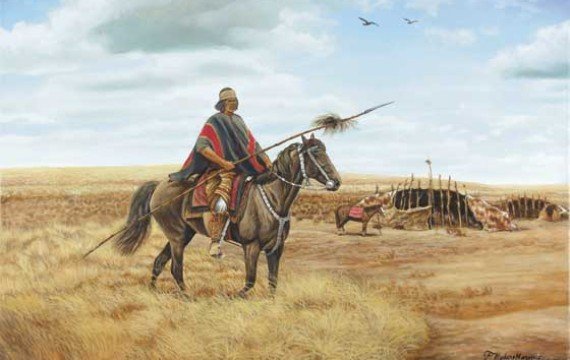
PAMPAS Generally speaking, Pampas are the native ethnic groups that lived on the big grasslands of the South American south cone. Over time several groups overlapped on this territory, so the term pampas is not very accurate and leads to frequent misunderstandings. The word “pampa” comes from the Quechua language, meaning plain; the Spanish who were coming from the Andean region after conquering Peru, called “Pampas” to the people living on those plains. These were the so-called “old Pampas” of “Het”, nomads who lived from haunting deer, rheas and guanacos. During the XVII...

Indigenous Peoples of Patagonia (I)


Before the Spanish conquerors arrived to America and later, during the second half of the XIX century, the armies of the new estates of Argentina and Chile launched their military campaigns, Patagonia and the Pampas where populated by different indigenous Peoples. Those Peoples have historically being called under the generic term of “Mapuche”, or “Araucanians”, as the Spanish used to call them. Nevertheless, originally those Peoples we not a homogeneous group, but diverse Peoples that were slowly absorbed both culturally and militarily but the Araucanians, in a long process of more than...

Lanin Volcano


Geography Lanín volcano, with a height of 3,776 m, is one of the highest peaks in Patagonia and an icon both for the Mapuche culture and the Neuquén province. It is located near the town on Junín de los Andes, on the border between Argentina and Chile. Three quarters of the volcano are on Argentinian territory, where it gives its name to the surrounding National Park, the Lanín National Park. The other quarter belongs to Chile, where is part of the Villarrica National Park.   Being in a relatively plain area, and surrounded by much lower mountains, Lanín is visible from very far away,...

Cave of the Hands


Cueva de las Manos (Cave of the Hands), on the west of Santa Cruz province, Argentine Patagonia, is one of the most important archeological sites in South America, featuring cave paintings that are the most ancient artistic expressions of the native people of the subcontinent. The site was declared World Heritage by the UNESCO in 1999.   The cave is indeed one of the stone walls of the amazing Pinturas River Canyon, an impressive basaltic formation of 200 m high and 150 Km long made by the erosion produced by the melting of the glaciers during the Pleistocene. The Pinturas River, also...

Perito Moreno National Park


Perito Moreno National Park (do not confuse with Perito Moreno Glacier, which is 450 Km south, in Los Glaciares National Park) is a protected area on the center west of the Santa Cruz province, in the southernmost part of the Argentine Patagonia. Limiting with Chile on its west side it has a surface of 115,000 has., covering a representative mix of the Patagonian Steppe and the humid Subantarctic Forest. The area was declared national park in 1937, and due to its isolation and harsh weather it is one of the most unknown national park in Patagonia. It also the less visited, with less than 2,000...

At Home with the Patagonians


At Home with the Patagonians is a book by the English explorer George Chaworth Musters, in which he describes the trip he took in 1870 together with the Tehuelches Indians (the Patagones) from the mouth of the Santa Cruz river, in the Southern Patagonia, to Carmen de Patagones, in the mouth of Río Negro, which sets the northern limit of the Patagonian territory. George Chaworth Musters Musters was the son of an English Army officer and one of his aunts took part on the Fitz Roy & Charles Darwin expedition on the Beagle. After serving in the English Navy, where he took part in the Crimea...

The Origin of the Word “Patagonia”


A lot has been said and written about the origin of the word "Patagonia", so I will try here to walk through the different theories and legends on the matter. The word "Patagonia" comes from "Patagones", which was the name given by the Portuguese mariner Fernando de Magallanes to the native people found on that part of the world during his 1520 expedition. The goal of the Magallanes expedition was to reach the Indies opening a new route to the West, and the voyage concluded with the first circumnavigation of the Earth which was completed by his subordinate Juan Sebastián Elcano. The expedition...

  • CONTACT

    info@tierraspatagonicas.com

    Phone: +54 2972 413 786
    Cel: +549 2944 710 762

    San Martín de los Andes
    Patagonia Argentina

  • VIDEOS

  • Photos

    • ANDEAN PATAGONIA
    • SOUTHERN PATAGONIA
    • ATLANTIC PATAGONIA
    • BIRDWATCHING PHOTOGRAPHY
  • Recent Posts

    • Birds of Patagonia: Patagonian Sierra-Finch
      (Phrygilus patagonicus) The Patagonian Sierra-Finch is an endemic species of Patagonia...
    • Pillan Mahuiza Geopark
      Pillán Mahuiza Geopark, in San Martín de los Andes, Patagonia, Argentina, spans...
    • Birds of Patagonia: Silvery Grebe
      (Podiceps occipitalis) This sublime diver and swimmer is found in almost all Argentina,...
  • Popular Posts

    • The Andean-Patagonian Forest
      The Andean-Patagonian forests, also known as Subantarctic forests, spreads over steep...
    • Ruta 40, North and Cuyo Sectors
      Ruta 40 ("Route 40"), or National Route 40 is the longest and most spectacular road...
    • A Tour to The Marble Chapels
      The "Marble Chapels", in General Carrera Lake, Chile, are mineral formations made...

  • Categories

    Antrophology Birdwatching Books Fauna Fungi Geology History Lakes & Rivers Mountains National Parks Native People Paleontology Plants Route 40 Tours Uncategorized Volcanoes