• Home
  • Traveling Patagonia
  • Road Trips
  • Nature Expeditions
  • Trekking
    • Day Tours
    • Muti-day Expeditions
  • Birding Tours
    • Day Tours
    • Overnight Tours
    • North Patagonia Birding Tour
    • From the Atlantic Coast to the Andes
  • Logistics
  • Contact Us
  • About
  • Blog
  • Español

Copyright © 2016 Tierras Patagónicas

Indigenous Peoples of Patagonia (II)


PAMPAS

Generally speaking, Pampas are the native ethnic groups that lived on the big grasslands of the South American south cone. Over time several groups overlapped on this territory, so the term pampas is not very accurate and leads to frequent misunderstandings.

The word “pampa” comes from the Quechua language, meaning plain; the Spanish who were coming from the Andean region after conquering Peru, called “Pampas” to the people living on those plains. These were the so-called “old Pampas” of “Het”, nomads who lived from haunting deer, rheas and guanacos. During the XVII and XVIII centuries these groups got in touch with the Araucanians, who came from the Andean region. The Araucanians called the people of the pampas Puelches, “people from the East” and as well as other ethnic groups this Puelches were slowly absorbed by the Araucanians.

Along XVIII and XIX centuries these groups, once “araucanized”, settled on the area known as Salinas Grandes (Big Salt Lakes), on the border between the actual provinces of Buenos Aires and La Pampa, leaded by the big cacique Calfucurá (Blue Stone). Salinas Grandes was by that time a strategic spot, for two reasons: 1. Salt was a key commodity for the meat industry, as before the first refrigerators appeared, salt was the only method to preserve meat. 2. The Salinas were an obligatory “waypoint” on the routes that the Indians used to herd the cattle stolen on the Buenos Aires ranches to the mountain passes to Chile. Based on Salinas Grandes, Calfucurá managed to rule a huge territory, on the provinces of Buenos Aires, La Pampa, San Luis, south of Mendoza and parts for Neuquén and Río Negro.

Calfucurá was allied to Juan Manuel de Rosas, by then the leader of the Argentine Confederation; he even held the rank of colonel on Rosa’s army. This alliance, together with the ones stablished with several Ranquel, Huilliche and Tehuelche caciques allowed Calfucurá to rule this vast territory for long years, stopping the advance of the Argentinian and Chilean armies. With the fall of Rosas this balance broke down and Calfucurá was and enemy again, fighting the armies sent by presidents Urquiza and Mitre. Calfucurá was victorious on numerous occasions, moving over the Buenos Aires towns of Azul, Tandil, Junín, Olavarría, Bragado and Bahía Blanca. These strikes caused terror on the frontier line, and the need of the confederation government to face the problem of the indigenous attacks.

In 1870, supported by Ranqueles, Pampas, Araucanians and Pehuenches, Calfucurá attacked and devastated Tres Arroyos and Bahía Blanca, kidnapping women and stealing thousands heads of cattle. In 1872 he declared the war to president Sarmiento and putting together 8,000 lancers he sacked Veinticinco de Mayo, Alvear and Nueve de Julio, but was defeated in Bolivar by combined forces of General Rivas and warriors of cacique Cirpriano Catriel.

Calfucurá died in 1873, being followed by his son, Manuel Namuncurá (Stone Feet), who continue battling the Argentinian troops commanded by General Roca, already in the middle of the “Conquest of the Desert”. In 1875, together with Ranquel caciques, Namuncurá attacked Tres Arroyos, Tandil and Azul. He was finally defeated in 1884 in Ñorquín, Neuquén and then settled in Chimpay, Río Negro and later in San Ignacio, Neuquén, where he died at the age of 97. His son, Ceferino Namuncurá studied Theology on a Salesian school in Rome, where he died from tuberculosis. In 2007 he was beatified and he still gets a lot of popular devotion. In 2009 his remains were taken to San Ignacio, Neuquén.

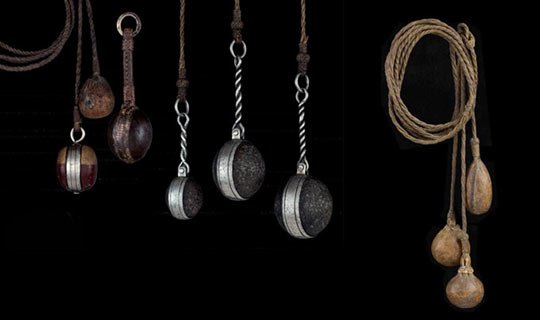
Exhibition-las-pampas

RANQUELES

Ranqueles were other of the native ethnic groups in Argentina. Apparently their origin is on the mix of several groups of “Hets” or Pampas with northern Tehuelches and Pehuenches. Their culture was araucanized with the arrival of the Mapuche, so Ranqueles are a subgroup of the Puelche nation, or “People of the East”.

First they lived of the bordering area between Neuquén and Mendoza, which was known as Ranquil or Ranquel. They called themselves Rankülche or “people of the reed beds”, a name that was hispaniziced as Ranqueles. By the end of XIX century they moved north, to the forests of Caldén, Algarrobo and Chañar trees, between Colorado and Cuarto rivers, settling on the territory south of La Pampa, San Luis and Córdoba.

Commanded by cacique Yanquetruz, they allied with Juan Manuel de Rosas on his fight again the unitarios in Córdoba. Once this alliance was broken by the attack of the caciques over Río Cuarto, Yanquetruz fought Rosas on the battles in Paso de la Balsa and Las Acollaradas, being defeated in Pampa del Mollo.

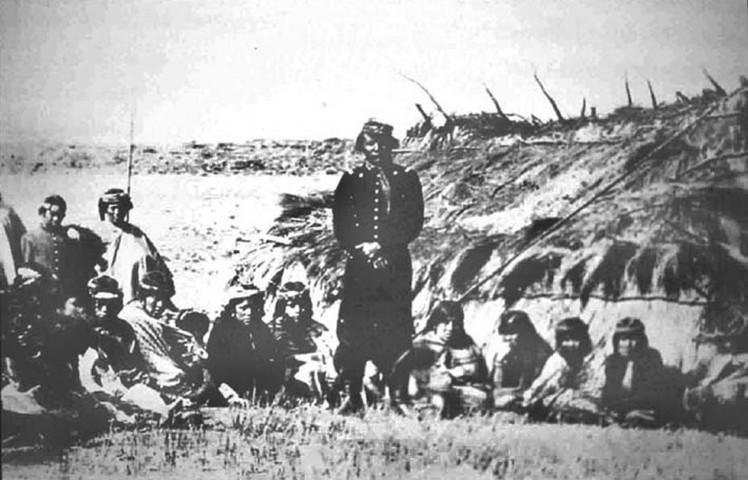
Ranqueles

Another major dynasty of Ranquel caciques were the Catriels, or “Scarface”. Juan Catriel backed Rosas’s campaigns and his grandson Cirprano Catriel fought Calfucurá on the San Carlos de Bolívar battle. Nevertheless his brother Juan José Catriel took part, together with Manuel Namuncurá on the sacks over Tres Arroyos, Tandil and Azul in 1875 (see above) being defeated in Cura Malal. In 1878 he was imprisoned together with other 500 warriors by Colonel Lorenzo Vintter and confined in the Martín García Island.

The Ranquel group was quite peculiar for having a significant European genetic component, as a result of the abundance of captive women taken during their raids over the territories controller by the creoles. Moreover, other of their main caciques was Manuel Baigorria, an Argentinian soldier of the unitarios side who was a refugee for long years on the Ranqueles encampments, running away from the federales side persecution.

Una excursión a los indios ranquelesMost of what we know about Ranqueles is thanks to the book wrote by Colonel Lucio V. Mansilla, Una Excursión a los Indios Ranqueles (“An excursion to the Ranqueles Indians”). Mansilla had been sent by the Sarmiento government to negotiate a peace treaty with the Ranqueles that allowed to extent the frontier with the Indians to the Quinto River. Together with two Franciscan monks and a small troop, Mansilla entered what by then was called “The Inland”, so to speak, the territory controlled by the Indians. He reached Leubucó, where the main Ranquel cacique by that time, Mariano Rosas, had his encampment. On his book Mansilla makes an excellent description of the customs, way of life, beliefs and behaviour of the Ranqueles and the creole captives and refugees who lived with them.

TEHUELCHES

Tehuelches or “Patagonians” were a group of indigenous peoples who lived on southern Patagonia. They called themselves Aonikenk but the Mapuche people called them Tehuelches (brave or bellicose people), this name being the most spread.

They were the first indigenous people in Patagonia to get in touch with the Spanish, when in 1520 the expedition led by Fernando de Magallanes disembarked in San Julian Bay to spend the winter there before continuing south bound searching for a pass from the Atlantic Ocean to the East Indies. In San Julián these explorers go in touch with the Tehuelches, being struck by the size of their footprints, so they called them “Patagones”, meaning “big feet”. That term is the origin of the name “Patagonia”.

Teheulches descent from nomad hunter-gatherers who lived in Patagonia during the last 10,000 years. These groups did seasonal migrations, following the moves of guanaco herds, which was a primary source for their feeding and clothing. They did not leave any written records, but we can know about them from numerous cave paintings spread around Patagonia. The most representative is the Cave of the Hands, in Santa Cruz province, where several guanaco and rhea haunting scenes are depicted.

Cave of the Hands, Santa Cruz

During the XVII and XVIII centuries, the Spanish introduced the horse and the Mapuche expanded from the east of the Andes, so the Tehuelches way of life suffered deep changes, slowly becoming cattle breeders and traders. There are numerous testimonials of the Tehuelches way of living during that period, like the writings of the English explorer George C. Musters. In 1870 he went with the Tehuelches on their annual voyage from the Pavón Inland, by the mouth of Santa Cruz River to Carmen de Patagones, on the south border of Buenos Aires province. He related this trip on his book At Home with the Patagonians.

Musters travelled with caciques Orkeke and Casimiro Biguá, the latter being the most important Tehuelche cacique. He made agreements with both the Argentinian and Chilean governments, depending on what was more useful on each moment, trying to maintain the integrity of his People. He received military ranks and supplies from both countries, finally choosing to swear loyalty to the Argentinian flag. He also fought for the Welsh settlers in Chubut, helping them to defend from Calfucura’s attacks.

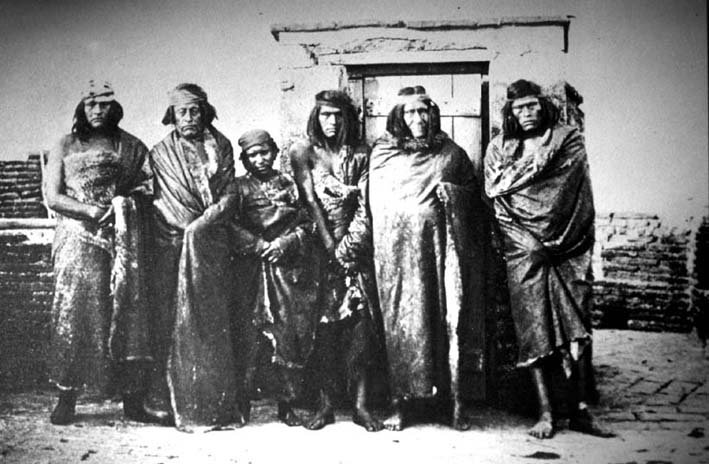
Tehuelches

Another major Tehuelche cacique was Inacayal, who lived in northern Patagonia, on the Limay River area. He was one of the last caciques to be defeated during the Conquest of the Desert. After that, he was imprisoned on the Martín García Island. Through the intervention of Perito Moreno, who was grateful to Inacayal for his hospitality during Moreno´s expeditions of the Nahuel Huapi Lake area, he was moved, together with his family, to La Plata Science Museum, where he died in 1888.

Moreno had contact with the southern Tehuelches as well, during his 1879 voyage along the Santa Cruz River, looking for its sources, an endeavour which Fitz Roy and Darwin could not complete in 1823. On his book about this expedition, “Viaje a la Patagonia Austral”, Moreno describes several encounters with the Tehuelches, as well as their customs and way of living.

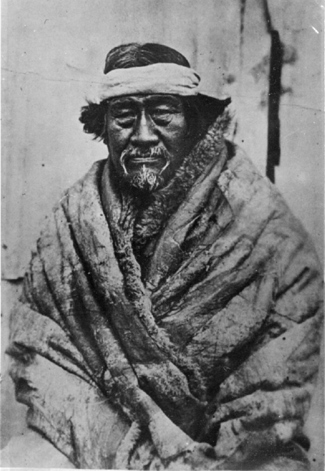
Aonikenk

After the Conquest of the Desert the Tehuelches were displaced to reserves on the most isolated and sterile areas of Patagonia, suffering a physic and moral degradation process that led to their almost total extinction. Nevertheless, there are still some communities of Tehuelche descendants in Santa Cruz province. The most important is Camusu Aike, 180 Km. from Río Gallegos, where its few inhabitants try to preserve the roots, the memory and the language of the Tehuelche People.

BIBLIOGRAPHY

Mansilla, Lucio V., Una Excursión a los Indios Ranqueles, Longseller, Buenos Aires, 2010.

Musters, George Chaworth, Vida entre los Patagones, El Elefante Blanco, Buenos Aires, 2004.

Moreno, Francisco P., Viaje a la Patagonia Austral, El Elefante Blanco, Buenos Aires, 2005.


Wanna say something?


  Cancel Reply

  • CONTACT

    info@tierraspatagonicas.com

    Phone: +54 2972 413 786
    Cel: +549 2944 710 762

    San Martín de los Andes
    Patagonia Argentina

  • VIDEOS

  • Photos

    • ANDEAN PATAGONIA
    • SOUTHERN PATAGONIA
    • ATLANTIC PATAGONIA
    • BIRDWATCHING PHOTOGRAPHY
  • Recent Posts

    • Birds of Patagonia: Patagonian Sierra-Finch
      (Phrygilus patagonicus) The Patagonian Sierra-Finch is an endemic species of Patagonia...
    • Pillan Mahuiza Geopark
      Pillán Mahuiza Geopark, in San Martín de los Andes, Patagonia, Argentina, spans...
    • Birds of Patagonia: Silvery Grebe
      (Podiceps occipitalis) This sublime diver and swimmer is found in almost all Argentina,...
  • Popular Posts

    • The Andean-Patagonian Forest
      The Andean-Patagonian forests, also known as Subantarctic forests, spreads over steep...
    • Ruta 40, North and Cuyo Sectors
      Ruta 40 ("Route 40"), or National Route 40 is the longest and most spectacular road...
    • A Tour to The Marble Chapels
      The "Marble Chapels", in General Carrera Lake, Chile, are mineral formations made...

  • Categories

    Antrophology Birdwatching Books Fauna Fungi Geology History Lakes & Rivers Mountains National Parks Native People Paleontology Plants Route 40 Tours Uncategorized Volcanoes