• Home
  • Traveling Patagonia
  • Road Trips
  • Nature Expeditions
  • Trekking
    • Day Tours
    • Muti-day Expeditions
  • Birding Tours
    • Day Tours
    • Overnight Tours
    • North Patagonia Birding Tour
    • From the Atlantic Coast to the Andes
  • Logistics
  • Contact Us
  • About
  • Blog
  • Español

Copyright © 2016 Tierras Patagónicas

Los Alerces National Park


Los Alerces National Park, considered one of the most beautiful in Argentina, is located in Patagonia, on the Andean region of the Chubut province with the Chilean border by its west side. The park has a total surface of 236,000 has., comprising several different ecosystems: the Valdivian Temperate Rain Forest, the Andean-Patagonia Forest, the High-Andean Steppe and the Patagonian Steppe.

The Alerce

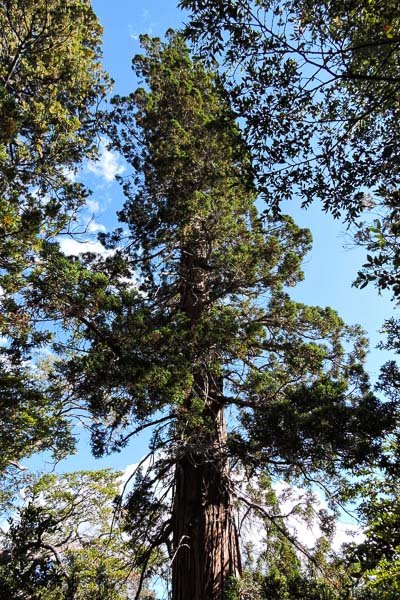
The park was created in 1937 with a main goal: protecting the pure forests of one of the most emblematic species of the Andean-Patagonian forests: the Alerce (Fitzroya cupressoides), or lahuán, as called by the native Mapuche people. A huge sized tree, frequently surpassing 50 m. tall, it belongs to the conifer family and its look it similar to the North American sequoias. It is evergreen, the leaves being small and scale-shaped. The trunk has an average diameter of 1 to 1.2 m, but in some specimens can reach up to 3 m. It is an extraordinary long-living tree, some specimens found in the park have reached the amazing age of 3,600 years old. That makes them the oldest living thing in Argentina and one of the oldest on Earth. They grow extremely slowly, around 1 mm. per year.


Despite its longevity the geographic distribution of the alerce is extremely limited and, on top of that, is retreating, that is why it is in need of protection. In Argentina it can be admired in the Chubut and Rio Negro provinces: in the Puerto Blest area and in Laguna Frías, both within the Nahuel Huapí National Park; near el Bolsón and Lago Puelo National Park, in the Río Azul and Esperanza Lake areas and of course in Los Alerces National Park, on the north and south arms of the Menéndez Lake and on the Cisne Lake.


Alerce (Fitzroya cupressoides)


On the west side of the Andes mountain chain, in Chile, the presence of the Fitzroya is also very restricted, due to the indiscriminate felling done during the first decades of the XX century. The cutting was done to use the wood to fabricate tiles to cover roofs and also to caulk ships using the resin that can be found just below the thick bark of the tree. The alerce has a chestnut-colored wood, soft-veined and with a fine and homogenous texture. It is a very light and has excellent quality, being almost rot-proof, that is why it was used in construction to cover the roofs that is typical of the Southern Chile architecture.


The alerce owes its name to a mistake made by the Spanish conquerors, who thought it was the same tree as the European alerce, the Larch, which belongs to the Larix family and has no relation the Patagonian Alerce. That is why, outside Argentina and Chile, and to avoid confusions, the alerce is known as “False Patagonian Cypress”. Its original name in the Mapuche people language is Lahuan or Lawan, meaning “cure” or “remedy” due to its anti-inflammatory properties.

Lakes and Rivers

Los Alerces National Park is made of a complex lake system, with two main sources: one starting out on the northwest, by the Cisne (Swan) Lake, which waters come from the Navarro and Alejandro Rivers. The Cisne Lake connects with the Menendez Lake, one of the biggest of the park, and then the Menéndez drains into a small one, the Verde (Green) Lake through the Menéndez River rapids. On the Verde Lake the two watersheds meet, the other one is coming from Rivadavia Lake, north of the national park, which waters come from the Tiger (Tiger) River, previously passing by the Cholila Lake.


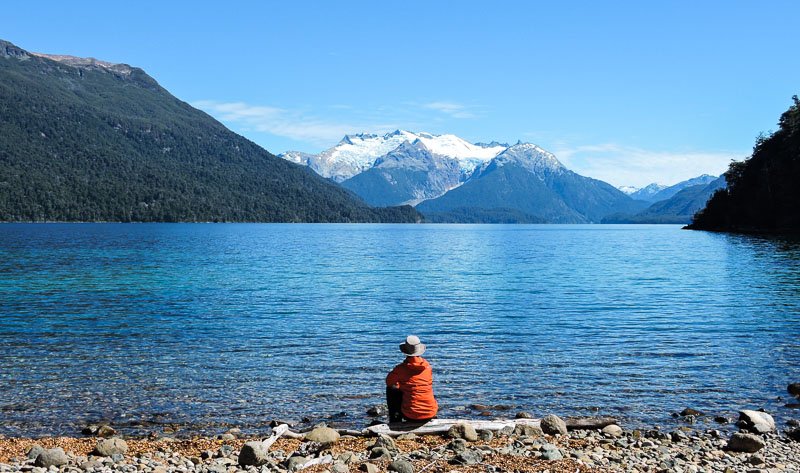
Lago Futalaufquen - PN Los Alerces


Once the two watersheds meet the Green Lake drains into the huge Futalaufquen Lake, the center of this hydrological system, through the Arrayanes River. By the southwest, the lakes Stange, Chico and Krugger make another water chain, that joining the south arm of Futalaufquen by the Monstruos (Monsters) Strait, made the Frey River. This river runs down south to reach the Amutui Quimeni reservoir, where there is a big hydroelectric complex called Futaleufú. The waters of the reservoir run into the Futaleufú River, which running towards the west and crossing the Chilean border finally flow into the Pacific Ocean through the Yelcho River.

Climate

The park’s weather, typical of the Andean-Patagonian region, ranges from temperate to cold, with cold and humid winters and temperate and dry summers. During summer the average temperature is 20ºC, but there are frequent frosts even in the middle of the season. In winter there is plenty of rain and snow. As on the entire Andean Patagonia, the humidity-charged winds hitting the barrier represented by the Andes mountain chain produce the most abundant precipitations along the strip near to the mountain chain, reaching 3000 mm. per year. Meanwhile, as the winds go East, the rainfalls decrease to 800 to 900 mm., determining a short transition from the Valdivian Rain forest, passing by the Andean-Patagonian forests and ending in a vast semi-arid space which is the Patagonian Steppe.


Glaciar Torrecillas - PN Los Alerces

Fauna

The park hosts numerous species of mammals, both autochthonous and exotic, the latter producing a significant impact to the native species, both animals and vegetables. Among the native mammals the two Patagonian deers, the Huemul (Hippocamelus bisulcus) and the Pudú (Pudu pudu) stand out; both are endangered due the illegal hunting, the destruction and fragmentation of its habitat and the introduction of livestock and exotic species like the Red deer.


There are plenty of predators, although they are hard to see: puma, huiña cat (austral spotted cat), huillín (an endangered native otter), culpeo fox and gray fox. The american mink, native from North America was introduced in the near town of Cholila, north of the park, to supply the fur market. In the 1970’s some specimens were released and now they breed inside the park, representing a threat to the native fauna due to its carnivorous habits.


As far as birds are concerned, up to 126 different species have been listed in the park, with a lot of endemics of the Andean Patagonian forests like the Magellanic Woodpecker, the Chucao Tapaculo, the Black-throated Huet-Huet, the White-crested Elaenia, the Thorn-tailed Rayadito, the Austral Parakeet and the Chilean Pigeon. On the lakes a rivers a lot of aquatic birds can be found such us Ashy-headed Geese, Great Grebe, Neotropic Cormorant, Southern Wigeon, Flying Steamer-Duck and Torrent Duck. There are also birds of prey and scavengers: condor, black vulture and black-chested buzzard-eagle stand out.


In rivers and lakes there is also a big range of fish, with presence as of autochthonous species like the perch, the sand smelt, the catfish and puyén, as well as exotic species that were introduced for fly-fishing: four different varieties of trout (river trout, lake trout, brown trout and rainbow trout), as well as several species of salmon and the Buenos Aires sand smelt. These exotic species have been very harmful for the native fish.


Chucao Tapaculo (Scelorchilus rubecula)

Flora

Apart from the emblematic Alerce, mentioned above, that gives its name to the national park, the mountains that surround the park are covered with a thick deciduous forests of trees of the Nothofagus genus: Lengas, Ñires and Coihues, as well as Cordilleran Cypress, another conifer. On the lower and humid areas there is also Maniú (Sexagothaea conspicua) and the Chusquea Bamboo, typical representatives of the Valdivian Temperate Rain Forest. By the Rivadavia River banks, Verde Lake and the Arrayanes River there are also hundreds of Arrayanes (Chilean Myrtle) that gives its name to that river.


On the transition to the steppe, east of the park, the Radal (Lomatia hirsuta) and the Maitén (Amytenis boaria) can be found, mixed with Rosa Mosqueta bushes. The undergrowth is made of Chusquea Bamboo, Winter’s Bark, Darwin’s Berberis, Sambucus and Luma. On the soil of the forests there are plenty of ferns, mosses, lichens and fungus like the Llao-Llao (Cyttaria darwinii), a parasite that produces orange-colored tumors on the tree’s branches.


Llao llao fungi (Cyttaria darwinii)

Accesses and tourism

The park as three main accesses: the north gate, from El Bolsón and Cholila, enter by the Rivadavia Lake area; the central gate, coming by Route 40 from Esquel or Trevelin, enters to the Futalafuqen Lake and Villa Futalaufquen; the south gate enters by the Futaleufú Hydroelectric Complex, 26 Km. away from Trevelin. Entering by any of those gates you can go by the entire park north to south by Route 71 (unpaved), that goes by the Rivadavia and Futalaufquen lakes before reaching Villa Futalaufquen, a small village where there is a touristic information building of the National Parks Authority, together with several hosterías (lodging houses) and grocery stores. Along the entire Route 71 there are plenty of cabins and lodge houses to spend the night, as well as free camping areas and organized campings, most of them excellent.


Los Alerces National Park


Most tourists visit the park during summer, especially in January and February, while during the rest of the year the presence of tourists is almost non-existent. Numerous activities can be done within the park, the main ones being hiking and trekking, sailing by the lakes, sport fishing and watching flora and fauna. There are plenty of self-guided paths with different difficulty levels and with information along the way about the different autochthonous species that live in the park. Some of the most frequented ones are: going up from Puerto Limonao to a viewpoint where you can see the waterfalls of Los Pumas River (low difficulty, 2 hours), the path to Laguna Escondida (Hidden Lagoon) that goes from the Arrayanes River area (medium difficulty, 3 hours) and the trek to climb El Dedal Peak, where you can see part of Futalaufquen Lake, the Situación Peak and the Desaguadero River valley (high difficulty, 7 hours).


Autumn in Los Alerces NP


Regarding the boat excursions by the lakes, there is no doubt that the most attractive one is the combined excursion by boat and walking that starting from Puerto Limonao, sails the Futalaufquen Lake and the Arrayanes River; there you land again, walk the path to Puerto Chucao and from there sail again along the Menéndez Lake up to Puerto Sagrario, where you can walk again by the milleneal alerzal, a pure forest of alerces where you can admire “El Abuelo“, a 2,600 years old tree where the excursions ends.


4 Comments for Los Alerces National Park


Esquel to Mendoza: Finishing the bike trip with volcanoes and wine | Wind Wine and Wheels: Pedalling Patagonia

[…] spent the next 3 days in the spectacular Los Alerces national park. Thick forests of huge Alerce trees, apparently up to 2500 years old, bordered huge lakes of […]

Reply

Dave Ellis

Great info on Alerce Park and looking forward to seeing it in December….thanks for the good work.

Reply

Patagonia

[…] Bariloche: Los Alerces National Park, Kruger and Rivadavia (lakes), Lago Puelo National Park, Museo Leleque (museum), Nahuel Huapi Lake […]

Reply

Viajar a Patagonia: todo lo que debes saber - Talk Travel

[…] de Bariloche: Parque Nacional Los Alerces, Lagos Kruger y Rivadavia, Parque Nacional Lago Puelo, Museo Leleque, Lago Nahuel Huapi y Parque […]

Reply


Wanna say something?


  Cancel Reply

  • CONTACT

    info@tierraspatagonicas.com

    Phone: +54 2972 413 786
    Cel: +549 2944 710 762

    San Martín de los Andes
    Patagonia Argentina

  • VIDEOS

  • Photos

    • ANDEAN PATAGONIA
    • SOUTHERN PATAGONIA
    • ATLANTIC PATAGONIA
    • BIRDWATCHING PHOTOGRAPHY
  • Recent Posts

    • Birds of Patagonia: Patagonian Sierra-Finch
      (Phrygilus patagonicus) The Patagonian Sierra-Finch is an endemic species of Patagonia...
    • Pillan Mahuiza Geopark
      Pillán Mahuiza Geopark, in San Martín de los Andes, Patagonia, Argentina, spans...
    • Birds of Patagonia: Silvery Grebe
      (Podiceps occipitalis) This sublime diver and swimmer is found in almost all Argentina,...
  • Popular Posts

    • The Andean-Patagonian Forest
      The Andean-Patagonian forests, also known as Subantarctic forests, spreads over steep...
    • Ruta 40, North and Cuyo Sectors
      Ruta 40 ("Route 40"), or National Route 40 is the longest and most spectacular road...
    • A Tour to The Marble Chapels
      The "Marble Chapels", in General Carrera Lake, Chile, are mineral formations made...

  • Categories

    Antrophology Birdwatching Books Fauna Fungi Geology History Lakes & Rivers Mountains National Parks Native People Paleontology Plants Route 40 Tours Uncategorized Volcanoes