• Home
  • Traveling Patagonia
  • Road Trips
  • Nature Expeditions
  • Trekking
    • Day Tours
    • Muti-day Expeditions
  • Birding Tours
    • Day Tours
    • Overnight Tours
    • North Patagonia Birding Tour
    • From the Atlantic Coast to the Andes
  • Logistics
  • Contact Us
  • About
  • Blog
  • Español

Copyright © 2016 Tierras Patagónicas

The Baker River


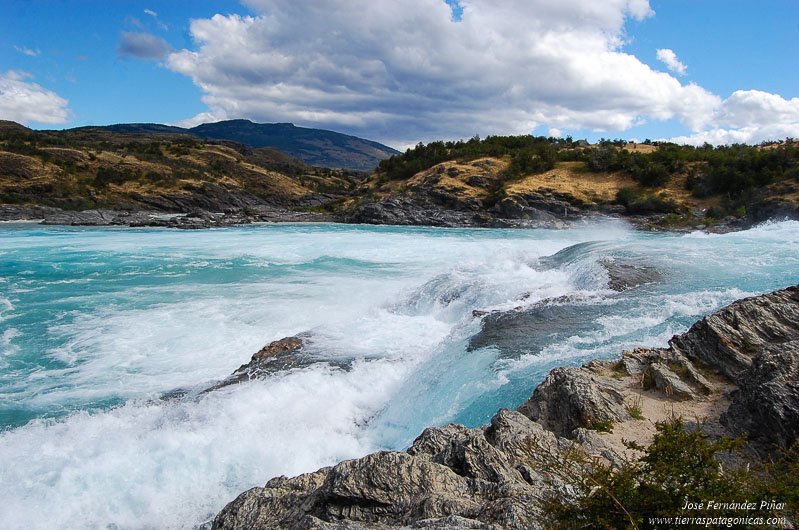
The Baker River in Chile, runs by the south of the Aysen Region, going from the Bertrand Lake to reach the Pacific Ocean in Caleta Tortel. It is the drainage of the huge bi-national Buenos Aires/General Carrera Lake, the second largest in South America, which is fed by the melting of the Northern Patagonian Ice Field. Along its course of 175 Km. the Baker River valley delivers unforgettable landscapes and an enormous environmental richness, being one of the main attractions of the Chilean part of Patagonia.


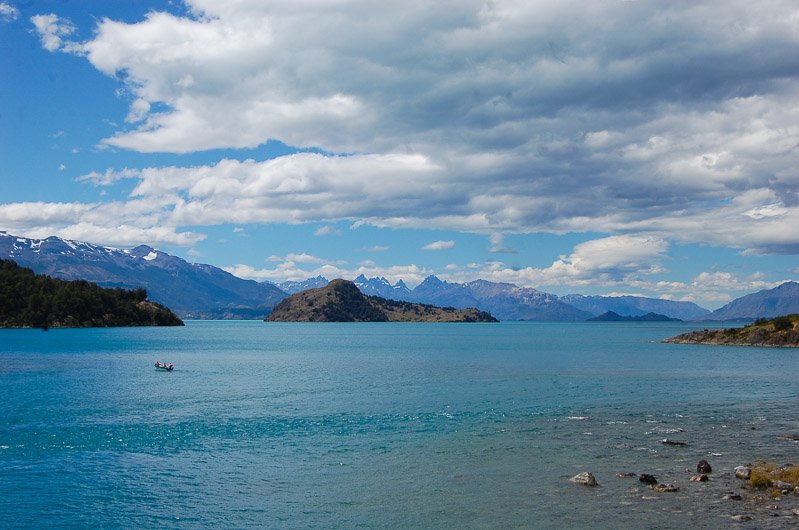
General Carrera Lake


From its source in the Bertrand Lake the Baker River is wide, carrying a great amount of an amazing turquoise-blue water. That color makes a big contrast with the surrounding landscape: the transition area from the arid Patagonian steppe in the Argentinian side to the temperate forests of the Chilean Patagonia. The Andes mountain range sets a barrier that blocks the humid winds coming from the Pacific, so the steppe on the other side of the mountains gets very little rain, less than 150 mm. per year. Despite the lack of rain some plants are well adapted to this terrain, like the coiron thick grasses and some shrubs like calafate and neneo. As you move to the west the landscape changes significantly, as the rain gradient increases to reach more than 4.000 mm per year at the Baker River mouth. First the Nothofagus forest show up, made up mainly of lenga (Nothofagus pumilio) and ñire (Nothofagus antarctica) trees.


Baker River


Further to the west we find also cohiue (Nothofagus dombeyi), guindo or “magellanic coihue ” (Nothofagus betuloides) and “cohihue of Chiloé” (Nothofagus nitida). At last the Valdivian temperate rain forest shows up, and the Nothofagus trees are joined by colihue cane, cipres de las guaitecas, arrayán, notro and copihue (Chile’s national flower), as well as plenty of mosses, ferns, climbing plants and epyphites. On the most humid sectors there are peat bogs; these are ancient glacier-origin lake basins that now receive abundant water supply from high glaciers melting. As they are nor sufficiently drained they go covered by a partially decomposed vegetal surface termed peat.


Valdivian rain forest, Caleta Tortel


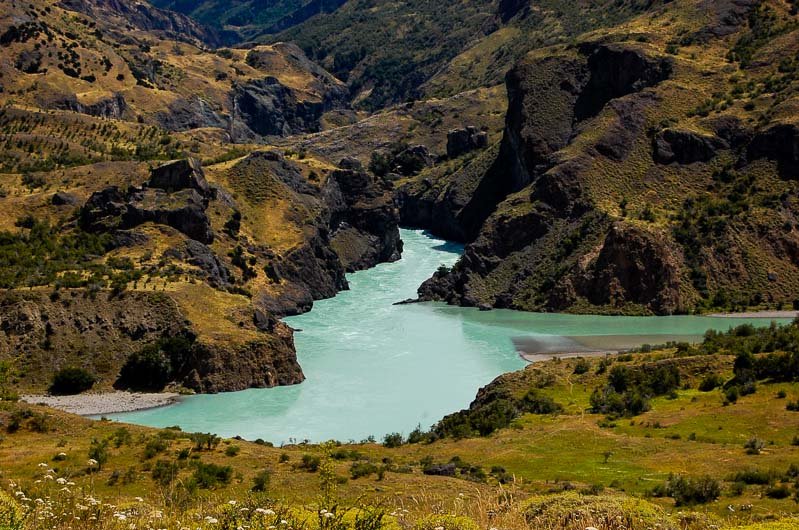
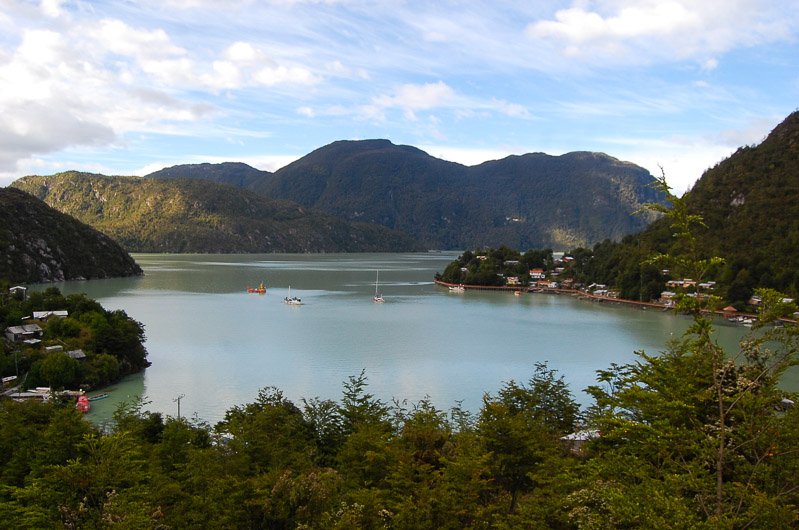
Along its course the Baker River receives inputs from several tributaries. The main ones are rivers Nef, Colonia and Ventisquero from the west and Chacabuco, Cochrane, Del Salto and Los Ñadis from the east. After the confluence with the Nef River, which waters come loaded with mineral sediments from the dragging of the Northern Ice Field glaciers, the Baker River turns its color to a milky blue. On the last stretch, from Cochrane to the river mouth in Caleta Tortel, Baker River goes deeper into the humid and cold Valdivian temperate rain forest, getting a greenish color that becomes very obvious in its estuary, where the river diverges into two different arms. On the river mouth the Baker waters get lost among a myriad islets separated by deep channels and spectacular fiords.


Confluence of rivers Baker and Neff


The river was called Baker after admiral Sir Thomas Baker, the chief of the English fleet on the South Pacific by the time that Charles Darwin explored Patagonia aboard the Beagle. The Baker River was explored for the first time as late as 1898, when the legendary German geographer Hans Steffen was hired by the Chilean government to explore the area. That was in the context of the Argentinian-Chilean conflict about the borders treaty signed in 1881. The Argentinian explorer Francisco Moreno was the first to reach the big lake from the east in 1876, naming it Buenos Aires, so the Chilean government wanted to study this unexplored zone in order to reassert the Chilean rights over the Baker River area.


Drainage of General Carrera Lake into Bertrand Lake


In 1903, once the border conflict was settled, Chile arranged the occupation of the Baker River valley, licensing the big Patagonian landowner Mauricio Braun, who by founding the Baker Exploitation Company introduced cattle for the first time in the area. In 1905 two hundred workers were relocated from the Chiloé Island to the Baker River mouth to build the company facilities and to open a road towards the Argentinian border. They were settled in Bajo Pisagua, very close to where Caleta Tortel is now, and started to build a house for the property administration, a livestock, a cowshed, a warehouse for tools and food and barracks for the workmen.


Baker River mouth


But after a few months some workers started to feel sick, with symptoms such as bruises on arms and legs, gastrointestinal disorders, head and muscle aches, dizziness…The workers remain isolated for more than eight months, bearing the intense southern cold, the torrential rains and the strong winds. Soon the first casualties happened, and to avoid contagion the corpses were buried in a tiny island on the river estuary. After more than 100 deaths finally a ship showed up to rescue the few survivors. What was meant to be a prosperous ranch turned into a tragedy and the Baker Exploitation Company went bankrupt.

Baker River mouth


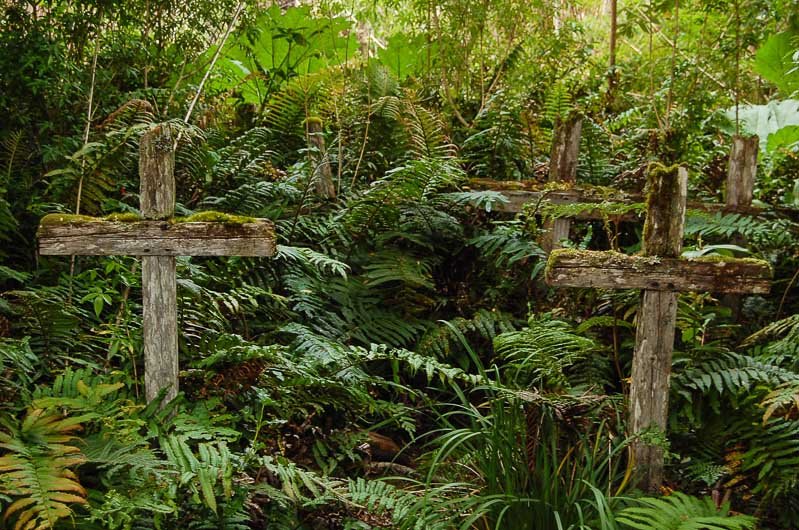
The true cause of the deaths was never cleared up. Some point to the scurvy, as a result of feeding on salted meat, fat, rice, beans and flour, without any fresh vegetables and fruits. Another theory says that the flour that the workers consumed could be contaminated with a pesticide for sheep that traveled on the same ship hold where the food was transported. A third hypothesis, even more tragic, is that the workers were deliberately poisoned by the company to avoid paying the salaries owed. The true story we probably will never know. The only witnesses are now the anonymous graves with a cross made of cypress wood that are in the now called Isla de los Muertos (The Island of the Dead). The island was declared “Historical National Monument” in 2001 and can be visited on a short boat excursion from Caleta Tortel.


Isla de los Muertos, Caleta Tortel


Nowadays the valley is living a new boost thanks to the growing of tourism in the area. A good part of the famous Carretera Austral, one of the most beautiful scenic routes in the world, goes parallel to the river course. The Baker River is also a first class destination for fly-fishing, kayaking and rafting. Its waters are among the purest in the world and are home to native fish species like perca and pejerrey as well as introduced one like salmon and brown and rainbow trouts. Puerto Bertrand, on the first part of the river offers a wide range of fishing lodges, guides and related services.

The towns of Cochrane and Caleta Tortel also thrive thanks to ecotourism. Cochrane is the access point to the Tamango National Reserve, one of the best protection areas for the emblematic Huemul (South Andean Deer), and to the Chacabuco River Valley, home of the future Patagonia National Park. Caleta Tortel, by the Baker River mouth stand out as a village without streets, being entirely built over pedestrian footbridges made of ciprés de las guaitecas wood. Is one of the most picturesque places in Patagonia so is receiving more tourists every year.

Caleta Tortel


Wanna say something?


  Cancel Reply

  • CONTACT

    info@tierraspatagonicas.com

    Phone: +54 2972 413 786
    Cel: +549 2944 710 762

    San Martín de los Andes
    Patagonia Argentina

  • VIDEOS

  • Photos

    • ANDEAN PATAGONIA
    • SOUTHERN PATAGONIA
    • ATLANTIC PATAGONIA
    • BIRDWATCHING PHOTOGRAPHY
  • Recent Posts

    • Birds of Patagonia: Patagonian Sierra-Finch
      (Phrygilus patagonicus) The Patagonian Sierra-Finch is an endemic species of Patagonia...
    • Pillan Mahuiza Geopark
      Pillán Mahuiza Geopark, in San Martín de los Andes, Patagonia, Argentina, spans...
    • Birds of Patagonia: Silvery Grebe
      (Podiceps occipitalis) This sublime diver and swimmer is found in almost all Argentina,...
  • Popular Posts

    • The Andean-Patagonian Forest
      The Andean-Patagonian forests, also known as Subantarctic forests, spreads over steep...
    • Ruta 40, North and Cuyo Sectors
      Ruta 40 ("Route 40"), or National Route 40 is the longest and most spectacular road...
    • A Tour to The Marble Chapels
      The "Marble Chapels", in General Carrera Lake, Chile, are mineral formations made...

  • Categories

    Antrophology Birdwatching Books Fauna Fungi Geology History Lakes & Rivers Mountains National Parks Native People Paleontology Plants Route 40 Tours Uncategorized Volcanoes