• Home
  • Traveling Patagonia
  • Road Trips
  • Nature Expeditions
  • Trekking
    • Day Tours
    • Muti-day Expeditions
  • Birding Tours
    • Day Tours
    • Overnight Tours
    • North Patagonia Birding Tour
    • From the Atlantic Coast to the Andes
  • Logistics
  • Contact Us
  • About
  • Blog
  • Español

Copyright © 2016 Tierras Patagónicas

The Patagonian Steppe


An ecoregion or ecological region is a relatively large biogeographical area characterized by the unique features of its ecology, climate, geomorphology, soils, flora and fauna. The Taiga, the African Savanna, the Mediterranean Forest or the Amazonian Jungle are good examples of ecoregions.

The Patagonian Steppe is the ecoregion that covers most part of Patagonia, around 730.000 Km² in southwest Mendoza, centre of Neuquén, southwest of Río Negro and most of Chubut and Santa Cruz, except their west side. The steppe borders the Andean-Patagonian forest on the west, the Monte region on the north and the Atlantic coast on the east.

TOPOGRAPHY AND CLIMATE

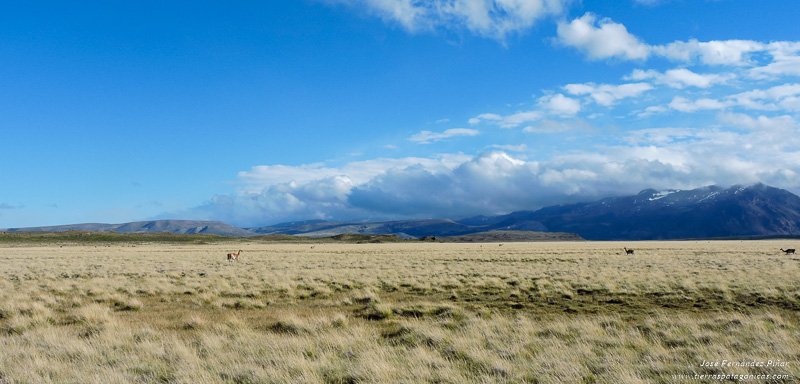
The steppe topography features vast plains, hills, stepped plateaus, river valleys and canyons. The soils are rocky and sandy, lacking rich organic materials. The weather is temperate-cold, with snow in winter and frosts almost at any time of the year. Precipitations are scarce, ranging from 100 to 300 mm per year and are concentrated on the coldest months, from April to September. In spring and summer strong west winds blow almost constantly. All these characteristics define and dry climate that determines the life of the plants and animals living in this territory.

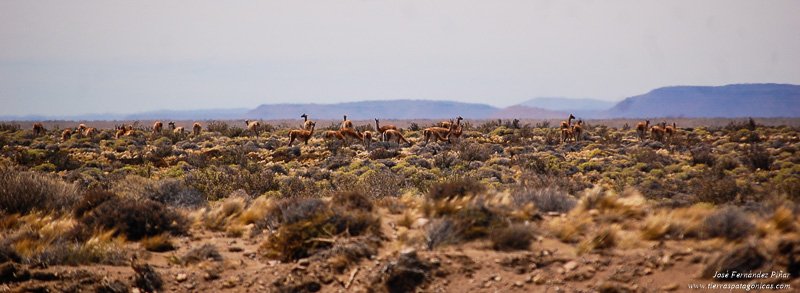
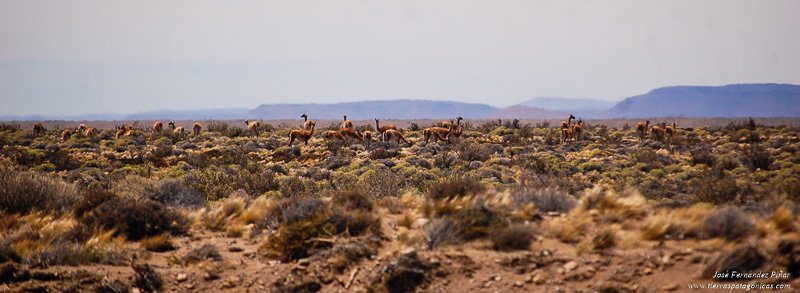
Patagonian steppe, Route 40

FLORA

The steppe vegetation is mainly made of two types of plants: low shrubs with small leaves and thorns and grasslands of the Stipa and Festuca genuses. Approximately 45% of the steppe’s territory is made of arid shrubby lands, 20% of grasslands, 30% of a combination of shrubs and grasslands and the remaining 5% of water bodies (rivers and lakes), wetlands and meadows.

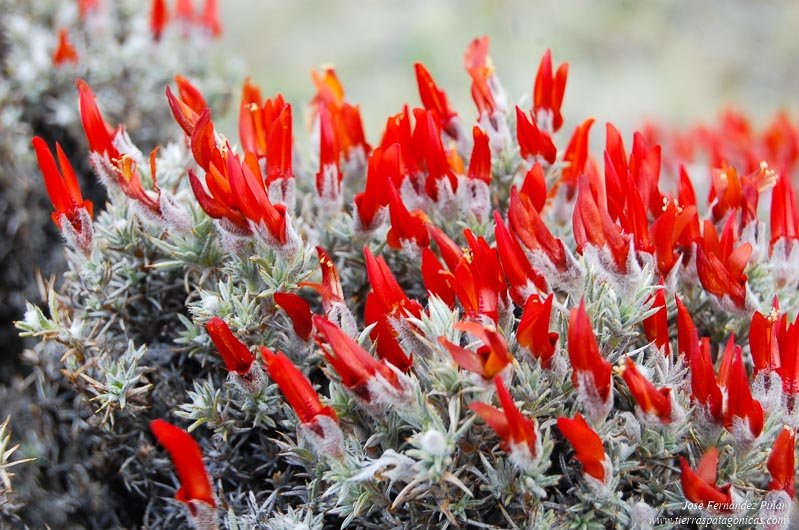
The most common shrubs are Neneo (Mulinum spinosum), Calafate (Berberis heterophylla), Molle (Schinus sp.), Quilembai (Chuquiragua avellanedae), Mata de fuego (Anarthrophyllum desideratum), Colapiche (Nassauvia glomerulosa), Mata negra (Junellia tridens) and the Jarillas of the Larrea genus. The grasslands are made Coirones, evergreen grasses provided with hard and sharp leaves that form short and compact bushes. The most common are the White (or sweet) Coirón (Festuca pallescens), the Bitter Coirón (Stipa speciosa), the Poa Coirón (Poa ligularis) and the Fueguian Coirón (Festuca gracillima).

Mata de fuego (Anarthrophyllum desideratum)

REPTILES AND AMPHIBIANS

Reptiles are well adapted to arid environment of the Patagonian Steppe, so there is a good amount of endemic species, like the lizards of the Liolaemus genus. Among them is the southernmost species of the sauropods in the world, Liolaemus magellanicus. Other inhabitants of the steppe are Matuastos (Diplolaemus sp.), lizards provided with a big head, thin neck, robust body and short legs, and Geckos (Hormonata darwini), saurians of nocturnal habits that feed from insects. Yarará Ñata (Bothrops ammodytoides) lives in the northwest of Santa Cruz province and is the southernmost venomous snake in the world. Among the amphibians we can mention the Patagonian Frog (Atelognathus patagonicus) and the Frog of the Basalt (Atelognathus praebasalticus ).

Petrified Forest, Santa Cruz

BIRDS

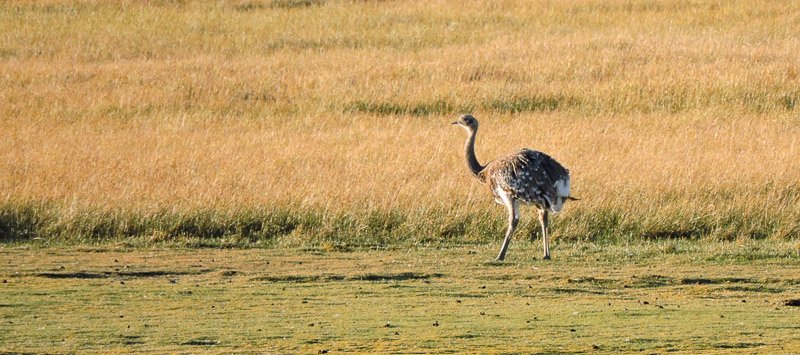
There are more than 100 bird species on the Patagonian steppe, that without taking into account the ones living on aquatic environments. Probably the most representative and the easiest to identify is the Lesser Rhea (Rhea pennata), a big flightless bird with long and strong legs. Lesser Rhea belong to the ratites, a group of birds that lost the ability to fly, so they lack the characteristic big breastbone of the flying birds. Biologically, they are a very ancient group originate in the Gondwana super-continent. The African ostrich and the emu in Australia also belong to this group.

Lesser Rhea

Another typical bird of the arid environments are the tinamous. In Patagonia we can find the elegant-crested Tinamou (Eudromia elegans) and the Patagonian Tinamou (Tinamotis engoufi). In wetlands we can find also seedsnipes, which move in small groups among the short vegetation. The most common is the least seedsnipe (Thinocorus rumicivorus). The burrowing parrot (Cyanoliseus patagonus), lives on the shrubby steppes where they feed from the bushes fruits.

Elegant Crested-Tinamou (Eudromia elegans)

As far as birds of prey are concerned the Black-chested Buzzard-Eagle stands out but also Red-backed Hawk (Buteo polyosoma), Cinereous Harrier (Circus cinereous), Peregrine Falcon (Falco peregrinus), American Kestrel (Falco sparverius) and Burrowing Owl (Athene cunicularia) can be found.

Cinereous Harrier, male (Circus cinereous)

The steppe host a good number of ovenbirds, a family of dull-colored insectivore birds found in Mexico, Central and South America. Miners (Geositta spp.), Earthcreepers (Upucertia spp.), Canasteros (Asthenes spp.), White-throated Cacholote (Pseudoseisura gutturalis) and Plain-mantled Tit-Spinetail (Leptasthenura aegithaloides) they all belong to this group. A different family of insectivore birds are the tyrant flycatchers, with several species on the Patagonian steppe like the Shrike Tyrants (Agriornis spp.), the Chocolate-vented Tyrant (Neoxolmis rufiventris), the Rusty-backed Monjita (Neoxolmis rubetra) and the Ground-Tyrants (Muscisaxicola spp.). The latter are usually seen on the high-altitude Andean steppes.

Scale-throated Earthcreeper

Another bird family present on the steppe are the Emberizidae, which feed mainly on seeds and grains so they have a suitable thick cone-shaped bill. Common Diuca-Dinch (Diuca diuca), Patagonian Yellow-Finch (Sicalis lebruni), Gray-hooded Sierra-Finch (Phrygilus gayi) and Mourning Sierra-Finch (Phrygilus fruticeti) belong to this group. Other prominent birds of the Patagonian Steppe are the Patagonian Mockingbird (Mimus patagonicus), the Correndera Pipit (Anthus correndera) and the Long-tailed Meadowlark (Sturnella loyca).

MAMMALS

There are several types of mammals of the Patagonian steppe. Most of the are small-sized, although there are a few exceptions. The bigesst and most representative if the Guanaco (Lama guanicoe), and herbivore of the camelid family, capable of digesting the thick grasses and the sprouts of some shrubs. It is a gregarious animal who lives in groups made of a dominat male with several females and their offspring. Its main predator in the Puma (puma concolor), the most widely-spread feline in America, living from Alaska to southern Patagonia.

Guanacos in Mié lagoons, PN Perito Moreno

Two different foxes live on the steppe, the Red Fox (Lycalopex culpaeus) and the Grey Fox (Lycalopex gymnocercus), which is smaller. Both are territorial, solitary and quite noctural, although they can be seen at any time of the day. They are opportunist, so their diet is very variable, including rodents, hares and rabbits, eggs, reptiles, insects and also fruits and vegetables.

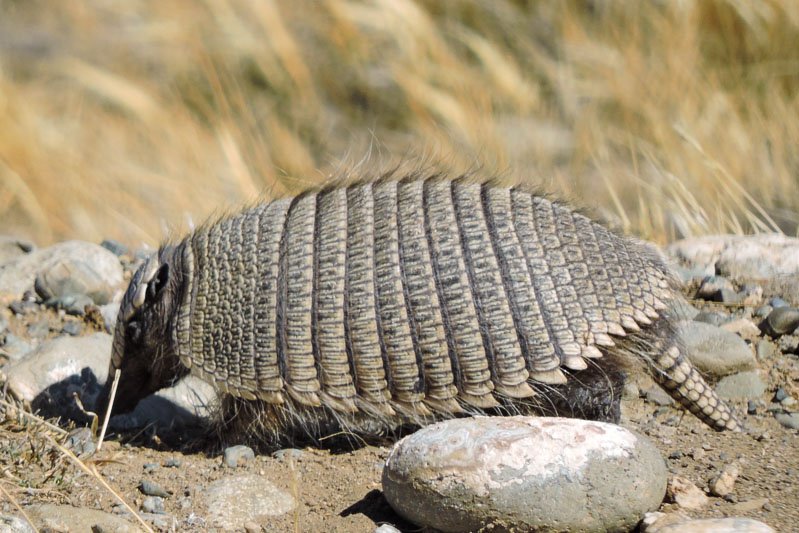
Another group of mammals are the armadillos, a family exclusive of America. They have the skull and the back covered by an armor of articulated plates providing them protection. They have strong claws that they use to excavate caves where they hibernate in winter. The two species in Patagonia are the Larger Hairy-armadillo (Chaetophractus villusus) and the Pichi (Zaedyus pichiy).

Larger Hairy-armadillo

Patagonian Mara is a big-sized rodent, endemic of the Patagonian steppe and the Monte region. Its look is similar to a hare, but provided with much longer legs. They are gregarious, living in groups of up to 70 individuals. They feed from leaves, stalks and roots of a lot of different plants. Their populations have decreased a lot as a result of the introduction of the European Hare. Also in the rodents group there is the Mountain Viscacha (Lagidium viscacha), who lives on rocky and sheer areas on dry and sparsely vegetated environments. Its fur is dense and soft, colored in grayish chestnut.

Lastly, other mammals on the Patagonian steppe are the Pampas Cat (Lynchailurus pajeros), the Patagonian Skunk (Conepatus humboldtii), the Patagonian opossum (Lestodelphys halli), the Patagonian Weasel (Lyncodon patagonicus) the Lesser Grison (Galictis cuja), the Southern Dwarf Cavy (Microcavia australis) and the Tuco-tuco (Ctenomys spp.).

Patagonian Steppe


BIBLIOGRAPHY:

Bisheimer, María V. y Fernández Eduardo M., Parque Nacionales de la Patagonia Argentina, Neuquén, 2008.

Canevari, Marcelo y Vaccaro, Olga, Guía de Mamíferos del Sur de América del sur, L.O.L.A, Buenos Aires, 2007.

de la Vega, Santiago G., Patagonia, las leyes de la estepa, Contacto Silvestre Ediciones, Buenos Aires, 2010.

Ferreira, Marcela y Green, Lorraine, Flores de la Estepa Patagónica, Vázquez Mazzini Editores, Buenos Aires, 2011.

Narosky, Tito e Yzurieta, Darío, Aves de Patagonia y Antártida, Vázquez Mazzini Editores, Buenos Aires, 2004.


3 Comments for The Patagonian Steppe


SEEING THE WORLD THROUGH BOOKS » Blog Archive » Sandrine Collette-NOTHING BUT DUST

[…] The Patagonian steppe, where Rafael and his family lived, is a huge, flat area, best for the pasturing of sheep. https://www.tierraspatagonicas.com/ […]

Reply

Community: english for tourism | Pearltrees

[…] The Patagonian Steppe | Patagonian Lands. An ecoregion or ecological region is a relatively large biogeographical area characterized by the unique features of its ecology, climate, geomorphology, soils, flora and fauna. The Taiga, the African Savanna, the Mediterranean Forest or the Amazonian Jungle are good examples of ecoregions. The Patagonian Steppe is the ecoregion that covers most part of Patagonia, around 730.000 Km² in southwest Mendoza, centre of Neuquén, southwest of Río Negro and most of Chubut and Santa Cruz, except their west side. […]

Reply

Best Places to Elope in 2020 ⋆ Starscape Studios ⋆ Elopement Ideas

[…] of the park. It lies in a transition area between the Magellanic subpolar forests and the Patagonian Steppes. To top it off, the park borders Bernardo O’Higgins National Park to the west and the Los […]

Reply


Wanna say something?


  Cancel Reply

  • CONTACT

    info@tierraspatagonicas.com

    Phone: +54 2972 413 786
    Cel: +549 2944 710 762

    San Martín de los Andes
    Patagonia Argentina

  • VIDEOS

  • Photos

    • ANDEAN PATAGONIA
    • SOUTHERN PATAGONIA
    • ATLANTIC PATAGONIA
    • BIRDWATCHING PHOTOGRAPHY
  • Recent Posts

    • Birds of Patagonia: Patagonian Sierra-Finch
      (Phrygilus patagonicus) The Patagonian Sierra-Finch is an endemic species of Patagonia...
    • Pillan Mahuiza Geopark
      Pillán Mahuiza Geopark, in San Martín de los Andes, Patagonia, Argentina, spans...
    • Birds of Patagonia: Silvery Grebe
      (Podiceps occipitalis) This sublime diver and swimmer is found in almost all Argentina,...
  • Popular Posts

    • The Andean-Patagonian Forest
      The Andean-Patagonian forests, also known as Subantarctic forests, spreads over steep...
    • Ruta 40, North and Cuyo Sectors
      Ruta 40 ("Route 40"), or National Route 40 is the longest and most spectacular road...
    • A Tour to The Marble Chapels
      The "Marble Chapels", in General Carrera Lake, Chile, are mineral formations made...

  • Categories

    Antrophology Birdwatching Books Fauna Fungi Geology History Lakes & Rivers Mountains National Parks Native People Paleontology Plants Route 40 Tours Uncategorized Volcanoes