• Home
  • Traveling Patagonia
  • Road Trips
  • Nature Expeditions
  • Trekking
    • Day Tours
    • Muti-day Expeditions
  • Birding Tours
    • Day Tours
    • Overnight Tours
    • North Patagonia Birding Tour
    • From the Atlantic Coast to the Andes
  • Logistics
  • Contact Us
  • About
  • Blog
  • Español

Copyright © 2016 Tierras Patagónicas

Woodpeckers in Patagonia


Woodpeckers are a group of birds of the Picidae familiy found in almost all forest areas of the world. They feed mainly on insects and larvae living under barks or in wood, drilling the trees to reach the prey and extracting it with their long tongue. Some of them feed also in the ground. Their habitat and way of feeding determine some surprising adaptations and behaviours.  


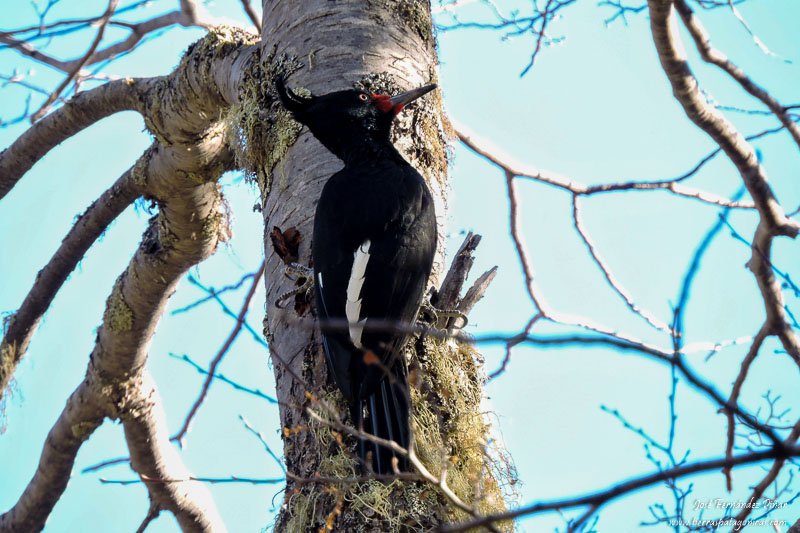
Magellanic woodpecker, female (Campephilus magellanicus)


The bill’s tip is chisel-shaped and is kept sharp by the pecking against the wood. It is made of three different layers designed to absorb the mechanical stress produced by the violent hammering. The skull, made of a hard but compressible bone, is also design to absorb the impacts preventing brain damage. The eyes have a third transparent eyelid called nictitating membrane that closes milliseconds before every impact protecting the eye from flying debris. The tongue, long and sticky, has bristles, aiding the woodpecker to grab and extract insects and larvae deep within a tree hole. Their feet have four toes, two of them facing forward and the other two backward, allowing them to grasp the limbs and trunks of trees. The tail end is a rigid surface, providing an extra foothold when perching on a vertical surface.     


Magellanic Woodpecker (Campephilus magellanicus)


They forage drumming the wood to look for hollow spaces that indicate the presence of grubs within the wood. Once found they drill strongly so they can introduce their bill and tongue where the larvae are. Their diet includes also ants, termites, spiders, beetles and other arthropods, small lizards and fruits. Feeding this way they play an important ecological role, keeping the forests free of mass infestations. Every breeding season the pair of woodpeckers excavate a tree cavity where they will nest, a task that can take up a month or even more. These cavities have also a great ecological value, as they are used later by other species (other birds, small mammals, insects) that nest on trunks but are not capable of excavating them.    


Woodpeckers are typically monogamous and territorial. Each pair will occupy a forest area and try to oust any other members of the species from their territory. They use the drumming as a territorial call, striking a wood surface rapidly to alert other individuals of their presence. Each species has a unique drumming pattern that is used also on courtship rituals. Both male and female contribute to excavate the nest, incubate the eggs and raise the chicks. These stay with their parent for a long time, up to two years in some cases, until they are capable of living on their own.    


Let us see now what woodpecker species are found in the Patagonian forests of Argentina and Chile. 


MAGELLANIC WOODPECKER 

The southernmost representative of the Campephilus genus, which includes eleven species of large woodpeckers, the Magellanic Woodpecker (Campephilus magellanicus) is one of the most iconic birds in Patagonia and one of the targets of any birder visiting our area. It is the largest woodpecker in South America and one of the largest in the world. Mainly black (in fact in Chile is called Black Woodpecker), except for the a white stripe on both sides of the wings, the male has an unmistakable crimson red head ended in a curved crest. The female’s head is entirely black, except for the base a the bill which is red. The crest of the female is much more prominent and curly, as you can see on the video below. Their eyes are golden-yellow, surrounded by a grey line and the tail is long and robust.


Magellanic woodpecker, male (Campephilus magellanicus)


The Magellanic Woodpecker it is an endemic species of the Austral Temperate Forests of South America where it is a permanent resident. They live up to 2,000 metres on mature forest with big trees of Nothofagus and Araucaria. They move within their territory in pairs or as a family group, typically a pair and a juvenile. Usually they are found through their drumming, consisting in one or two rapid beats, a common pattern of all species of the Campephilus genus. They also have several vocalizations, the most characteristic of which resembles a nasal laugh, as you can hear on this video.


They are specialized on feeding on large larvae of coleopteran insects living in the wood, although occasionally they can prey on small lizards or feed on Berberis fruits. To obtain the grubs they tap-drum the trunk to locate the gallery where the larvae are, then drill a hole and introduce their sticky tongue, which is four times larger than the bill to grasp them. Sometimes they feed from dead trunks on the ground. To prepare for the breeding season, which occurs from October to February, both male and female work intensively to excavate a cavity on some Nothofagus tree. This cavities are not reused and represent a valuable resource of the Patagonian forest as other species used them for nesting (Austral Parakeet, Rufous-legged Owl, Chilean Swallow) or as shelter (Green-backed Firecrown and the marsupial Dromiciops australis).  


On the last stages before nesting they enlarge the inner chamber and line it with wood chips. The female lays 1 to 2 eggs that both parents incubate for around 20 days. The chicks remain within the nest around 45 days being fed by both parents. Once they leave the nest they stay with the family group for a long period, being assisted by their parents until they are able to master the drilling technique and obtain big larvae by themselves. If juveniles have still not dispersed at the start of the following breeding season the adults become hostile and try to oust them from their territories. If juveniles do not accept the displacement the adults postpone the reproduction to the following year.


CHILEAN FLICKER 

The Chilean Flicker (Colaptes pitius) is the only woodpecker of the Colaptes genus in the Andean region of Patagonia, where it is a permanent resident. Other species, Campo Flicker (Colaptes campestris) and Golden-breasted Woodpecker (Colaptes melanochloros) can be found in open rural areas in north Patagonia. As opposed to Magellanic Woodpecker, that occurs exclusively in mature dense forest of Nothofagus trees, the Chilean Flicker likes more open areas on the Patagonian forests borders, transition forest to steppe areas and even rural and urban areas with brushes and trees. 


Chilean Flicker (Colaptes pitius)


It is big, with long and sharp bill, yellow eyes (light-blue in juveniles), dark grey head and light-brown face. The back is dark brown, finely barred in white while the chest is whitish and heavily barred and spotted in dark brown. The underparts are whitish and the tails is black and rigid. 


Chilean Flicker (Colaptes pitius)


Like all flickers is very terrestrial and gregarious, usually found in pairs or small groups of five or six individuals. They forage for ants and other insects and invertebrates on the ground, but like most woodpeckers they also like to perch on trees, drilling old or dead trees in search for insect larvae. Occasionally they might also feed on fruit. Chilean Flickers are curious, confident and very vocal, which makes them the easiest woodpecker to find on their distribution area. They have several vocalizations, the most characteristic is a loud warning call sounding pit-tweeo (see video below) repeated several times that gives this bird his onomatopoeic Spanish name, Pitío Woodpecker.  


They nest excavating on big trees or on ravine and steep slopes where they lay 5-6 white eggs that are incubated by both parents. They tend to breed more than one time per season and reuse the cavity for several years. 


STRIPPED WOODPECKER

The Stripped Woodpecker (Veniliornis lignarius) is the smallest woodpecker of the Patagonian forest, with just 15 to 18 cm. It is chunky and with a short chisel-shaped bill. Its plumage is mainly black and white, barred on the back and the tail and stripped on the chest and the belly. The head and the face are blackish, with two thick white stripes, one above and the other under the eyes, which are dark. The male has also variable-sized red patch on the nape that the female lacks.


Striped Woodpecker (Picoides lignarus)


It can be found on Nothofagus forests, scrublands, wood plantations and even gardens both in Argentina and Chile. Although quite abundant and confident is easier to ear than to actually seen it. They live in pairs or in family groups. Stripped Woodpeckers are exclusively arboreal, they move from one tree to another looking for insects and larvae on the wood. To extract the grubs they drill the wood with powerful strokes and then use their tongue to grab them. Their call is a sharp piiik! and their drumming consist of a strong and very rapid pattern. 


For nesting they excavate a hole on a living or standig dead Nothofagus tree, where they lay 3 to 5 white eggs over a bed of wood chips. They requiere mature trees and branches of a significant diameter. Both parents incubate the eggs and feed the chicks that leave the nest after 30 days. 


BIBLIOGRAPHY

Ojeda,Valeria, Breeding biology and social behaviour of Magellanic Woodpeckers (Campephilus magellanicus) in Argentine Patagonia.

Povedano, H.; Bisheimer, M.V. (2016) Aves Terrestres de la Patagonia.

Jaramillo, Álvaro, Birds of Chile, Princeton University Press, 2003.


Wanna say something?


  Cancel Reply

  • CONTACT

    info@tierraspatagonicas.com

    Phone: +54 2972 413 786
    Cel: +549 2944 710 762

    San Martín de los Andes
    Patagonia Argentina

  • VIDEOS

  • Photos

    • ANDEAN PATAGONIA
    • SOUTHERN PATAGONIA
    • ATLANTIC PATAGONIA
    • BIRDWATCHING PHOTOGRAPHY
  • Recent Posts

    • Birds of Patagonia: Patagonian Sierra-Finch
      (Phrygilus patagonicus) The Patagonian Sierra-Finch is an endemic species of Patagonia...
    • Pillan Mahuiza Geopark
      Pillán Mahuiza Geopark, in San Martín de los Andes, Patagonia, Argentina, spans...
    • Birds of Patagonia: Silvery Grebe
      (Podiceps occipitalis) This sublime diver and swimmer is found in almost all Argentina,...
  • Popular Posts

    • The Andean-Patagonian Forest
      The Andean-Patagonian forests, also known as Subantarctic forests, spreads over steep...
    • Ruta 40, North and Cuyo Sectors
      Ruta 40 ("Route 40"), or National Route 40 is the longest and most spectacular road...
    • A Tour to The Marble Chapels
      The "Marble Chapels", in General Carrera Lake, Chile, are mineral formations made...

  • Categories

    Antrophology Birdwatching Books Fauna Fungi Geology History Lakes & Rivers Mountains National Parks Native People Paleontology Plants Route 40 Tours Uncategorized Volcanoes